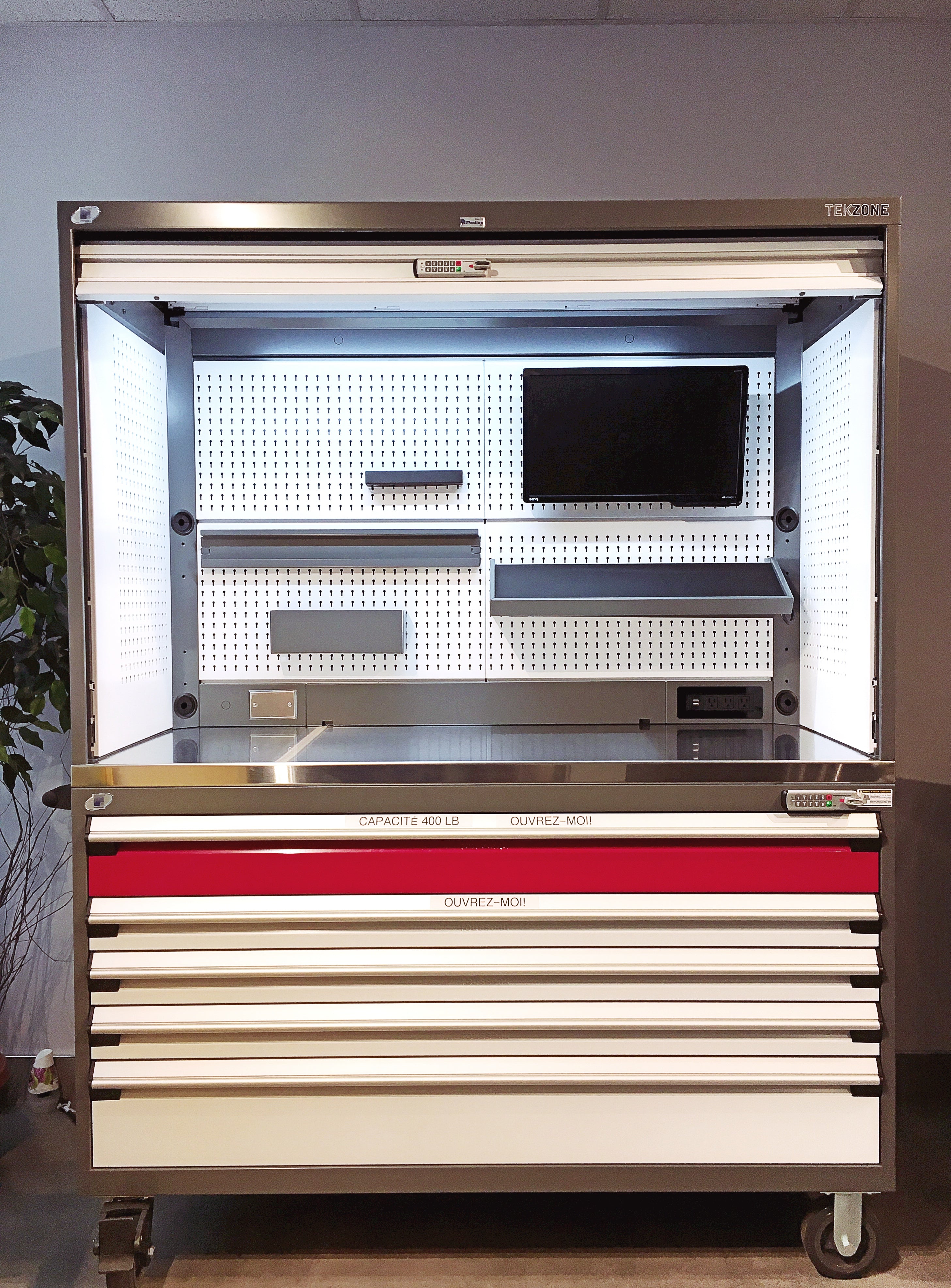
Making handling more ergonomic
The repetitive nature of physical work can become disabling for the worker, even if the load is light. And what about manual handling of heavy or bulky loads? This involves risks that can be costly to the employer.
As the saying goes, “Prevention is better than cure.”
(The rest of the article is only available in French)
In a context where well-being at work is more than a fad, but almost an obligation for the employer who wishes to keep his employees, the question of health and safety must not be taken lightly.
When we think of a production plant, what comes to mind is: automation, robotization, assisted handling. Lifting and handling systems such as overhead cranes, chain hoists, jib cranes are part of the industrial environment as we know it. But there are other high-performance systems: vacuum lifting systems ( with vacuum tubes ) that will significantly reduce work constraints. We are talking about assisted handling here.
This type of system (suction by tube and suction cup) allows you to fix the load, support it, lift it without fear of damaging the surface (and the edges of a product), move it and place it where you need it. Everything is done using a single command by the operator. This system will be chosen according to the weight of the load to be moved, the vertical and horizontal distances to be covered, the work environment.
The vacuum (made by suction) is used to fix and lift a load, eliminating the need for chain hoists or any other type of hook for handling. When the system's suction cups touch the load, the air flow is blocked, thus increasing the vacuum level (sealing) in the tube; this is called contraction of the lifting tube. And this contraction allows the elevation [1] of the load.
In addition, the vacuum is constantly monitored and regulated by the operator using a control handle (handle that controls the suction flow as well as the lifting or lowering speed). When the vacuum decreases, the lifting tube expands, thus lowering the load.
The choice of suction cups is made according to the load. There are a variety of suction cups available depending on the different surfaces [2] of fillers (non-porous, semi-porous and porous) and the styles of fillers: loose or dense, light or heavy, compact or bulky. Example of fillers: cardboard boxes, bags, drums, panels, sheets, etc.
Also, the choice of the chosen system will depend on your load lifting requirements. The actual capacities of the system vary depending on the nature of the load (watertight or porous product), the condition of the surface (cleanliness, roughness), the useful surface area of the suction cup, the shape (dimensions) of the product and the deformation of the suction cup (influenced by the vacuum level, the force exerted, the shape of the suction cup, the material of the suction cup).
Designed for high production use, This vacuum lifting aid device is ergonomic , because it respects the natural fluidity of the operator's movements. In addition, it significantly reduces the risk of injury related to manual handling.
To summarize, this type of lifting system can help you:
- To increase your productivity while providing an ergonomic solution to your handling needs;
- For packaging, palletizing, stacking, loading and unloading bags, etc.
Finally, the vacuum handling system can be mounted on a rail, an overhead crane, a monorail, a jib crane or any other similar accessory.
Want to know more?
Contact us at info@pedlex.com
[1] The suction cups are adjusted to the surface to be handled. If the seal is suitable, a vacuum is produced in the pipe by suction. There is contraction.
[2] In the event of a power failure or pump malfunction, a built-in safety check valve helps maintain vacuum in the lift tube, allowing the elevated load to slowly and gently lower back to the ground.